
The Systems We Live In and the Systems We Build: AI Journey of a TechUP Learner by Sebastian Moore

Share This
I grew up in the care system in County Durham. I say that plainly now, but for a long time I said it quietly, if at all. There is still a part of the world that hears “care leaver” and adjusts its expectations downward. I spent a long time adjusting mine upward to compensate.
What I know now, and wish I had understood sooner, is this: potential is evenly distributed, even if opportunity is not. The difference between the two is the terrain.
Why AI, why now
I work in the Government Digital and Data profession, where much of my time is spent helping public sector organisations understand, adopt, and govern artificial intelligence. I see use cases arrive, dozens of them, across every kind of public service, and I see organisations wrestling with questions they are not yet equipped to answer: What data are we using? Who is affected? What happens when it goes wrong?
These are questions about systems, and I have spent my whole life thinking about systems, specifically the ones that were not designed with people like me in mind.
That is why I enrolled on the TechUP’s Artificial Intelligence: Foundations for Practice and Research course at Durham University. The motivation was not credentials or a profile addition, but a rigorous, research-grounded understanding of what AI actually is, what the evidence actually says, and what governance of it actually requires. Practice without foundations is just confidence, and I wanted something more durable.
What I found

The course was structured across seven modules, moving from foundational AI concepts through machine learning, ethics and bias, interdisciplinary applications, and generative tools. The sequencing matters: by the time you reach the harder questions about accountability and governance, you have enough technical grounding to ask them properly. That kind of discipline, building the foundations before reaching for the conclusions, is rarer in this field than it should be.
The module on ethics, bias, and responsible AI was the one I returned to most. I work in a policy environment where the phrase “responsible AI” is used fluently by people who have not examined what it actually requires. The course did not let me be one of them. It pushed me to distinguish between the rhetorical version of AI governance and the substantive one: between frameworks that signal intent and frameworks that produce accountability.
The module on AI in interdisciplinary contexts was equally useful. It pressed on a question I think about constantly: Who gets to shape how AI is deployed, and in what institutional settings? The answer to that question is not neutral, and the course did not treat it as if it were.
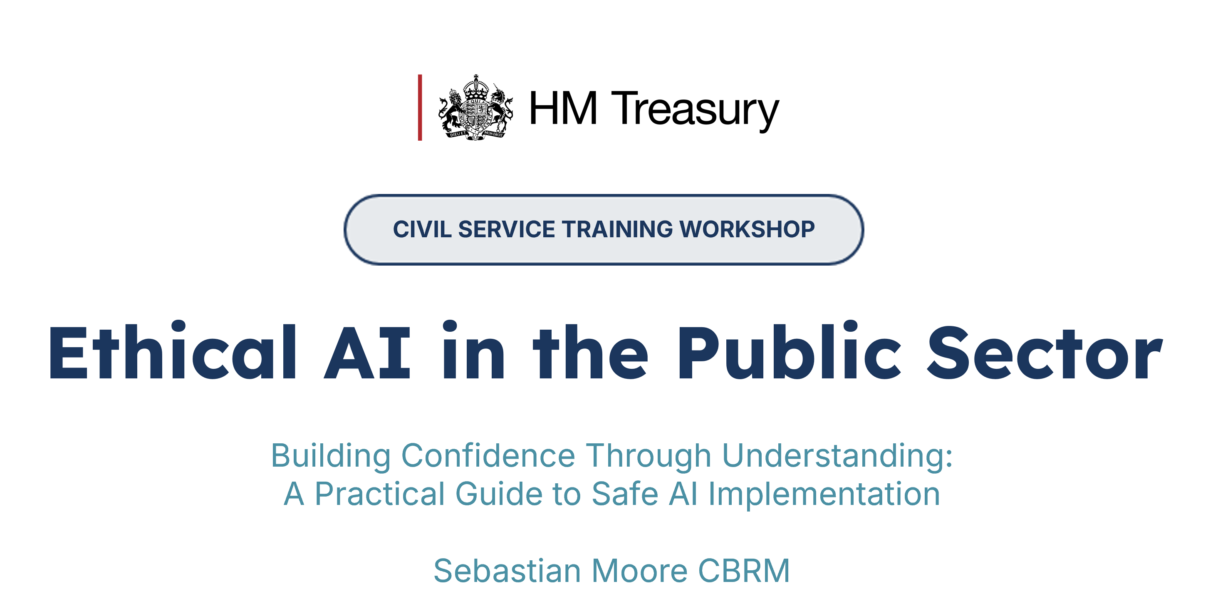
For the capstone, I designed an Ethical AI in the Public Sector Workshop, a structured resource for practitioners navigating AI adoption in government contexts. It brought together everything the course had built: the technical literacy, the governance framing, and the conviction that people closest to public services need to be equipped to interrogate the systems they are being asked to use.
Self-compassion as Strategy
I want to say something that career narratives tend to omit, because they flatten the journey into a sequence of achievements: The path from the care system into a professional career in technology is not a straight line.
There are stretches of time spent simply surviving. There is profound self-doubt. There are moments when the gap between where you are and where you want to be feels less like a challenge and more like a verdict.
Self-compassion is often misread as softness. It is what allows you to keep going when the evidence around you has not yet caught up with what you know you are capable of. Be patient with yourself, build one skill at a time, and trust that the accumulation is meaningful even when you cannot yet see what it is accumulating toward.
What Comes Next
I am completing a Master’s degree in Digital & Technology Solutions, with a focus on AI governance and public sector transformation. I co-founded the Cross-Government Care Leavers’ Network, and I recently used AI-assisted analysis to investigate the invisible entitlements of care-experienced young people accessing apprenticeships, producing research that is now informing national policy.
The systems we inherit are imperfect. Understanding them honestly is the precondition for building something better, and that, more than anything, is what this course gave me.
Sebastian Moore is an AI and digital transformation professional in the Government Digital & Data profession, Global Top BRM 2026, AI 100 UK, and co-founder of the XGov Care Leavers’ Network.
If you’d like to find out more about TechUP’s Artificial Intelligence: Foundations for Practice and Research programme and register for updates on our next intake, visit our webpage below: