

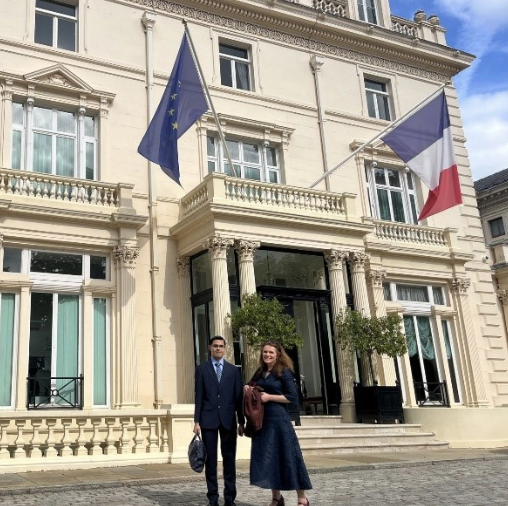
A wonderful opportunity dropped into the TechUP mailbox back in April of this year. It was an invitation from Dr Laura Di Chiacchio to join the Franco-British Data Society and Aston University at the French Embassy in Kensington to discuss “AI Trust and Inclusion”. Two members of our team were available to attend – Addy Shah and Dr Paula Beer. The event was to be held at the beautiful French Embassy in Kensington Palace Gardens, London.
In the week prior to the event all delegates were invited to attend a webinar entitled “Machine Intelligence vs Human Expertise How Organisations Fall into the AI Trust Gap”. The webinar was hosted by Dr Laura Di Characchio with Christophe Le Lannou from the Franco-British Data Society. During the webinar their guest, the philosopher Professor Shannon Vallor from The University of Edinburgh, shared reflections from her book “AI Mirror”.
Professor Vallor argues that artificial intelligence reflects human values, biases, and moral limitations back to us. Rather than being neutral tools, AI systems expose ethical shortcomings in their creators and societies, challenging us to cultivate virtues, responsibility, and critical awareness so technology development aligns with genuine human flourishing. She also shared her recent thoughts on practical results of a lack of awareness of this mirror effect. One example that she described was a recent study with Microsoft Copilot.
In this experiment Professor Adam Kucharski (who specialises in epidemiology and statistics) asked Copilot to analyse a large health questionnaire dataset and identify the key differences between the US and UK responses. To demonstrate the problem with Copilot Professor Kucharski had fed Copilot two identical datasets.
What Copilot did next is very concerning.
It generated a list of “significant” (but as it turns out fictional) differences between the US and UK responses, which were in fact identical. It is therefore clear that it had not examined the data but (in auto mode) had fabricated plausible differences from cultural stereotypes which exist on the Internet (and are therefore part of the LLM training data). Professor Vallor then posed the question:
What would prevent an organization from publishing or acting upon such findings?
This led to a discussion about the importance of expertise and how organisations need to value this alongside artificial intelligence. The discussion following her presentation was lively and the audience added other illustrations which were aligned with her thinking. It felt like a good primer for the for the upcoming forum.

Another great takeaway from the webinar was being introduced to “Better images of AI” which is an organisation which creates, collects and shares images of AI which are more inclusive, realistic and meaningful. Professor Vallor used this image entitled “Server pool – Ulysse Gerkens & FARI” which makes visible the massive water consumption required to cool data centres, and questions the allocation of resources to digital infrastructure, questioning what remains for culture.
On the Day of the Forum
We travelled to the Embassy and met numerous representatives from public bodies and charities as well as industry colleagues who are directly involved in the important work of implementing AI systems in a responsible and inclusive way. We had some great free form discussions as well as some directed roundtable discussions addressing questions which are very close to TechUP’s heart including: What would inclusive reshaping of AI talent pipelines actually looklike? & How do we build the talent pipeline companies need to adopt and integrate AI?
Naturally, we were able to talk about the ethos of TechUP plus our recently delivered online course “Artificial Intelligence: Foundations for Research and Practice” and describe how the broad eligibility criteria for this course resulted in a wonderfully diverse cohort of learners with a variety of backgrounds and domain expertise. Building a diverse talent pipeline for AI, and more broadly tech, means creating opportunities for everyone to take part in the conversation and ultimately work in tech to have their voice heard.
The Forum ended with an in-depth panel discussion from Prof. Ann Kristin Glenster (Cambridge University); Prof. Edward Harcourt (Oxford University) and Anna Bright (Sustainability West Midlands). The panel discussed “AI and the Future of Truth” which involved examining real-world risks of AI systems that fail to produce reliable outputs, the impact on organisations and society, and the pursuit of truth in the AI age.
It was a good day and demonstrated that although development and adoption of AI is happening at pace it is by no means “done”. There are still many questions to ask and frameworks to consider ensuring that whatever we do with AI it is for the good of society not just for short term “efficiency”.
If you are interested in learning more about The British-Franco Data Society, they can be reached on LinkedIn and they have a YouTube channel as well as upcoming in-person events.